What do people actually notice about a vending machine?
Not the specifications. Not the technology. At least not at first.
They notice the machine itself.
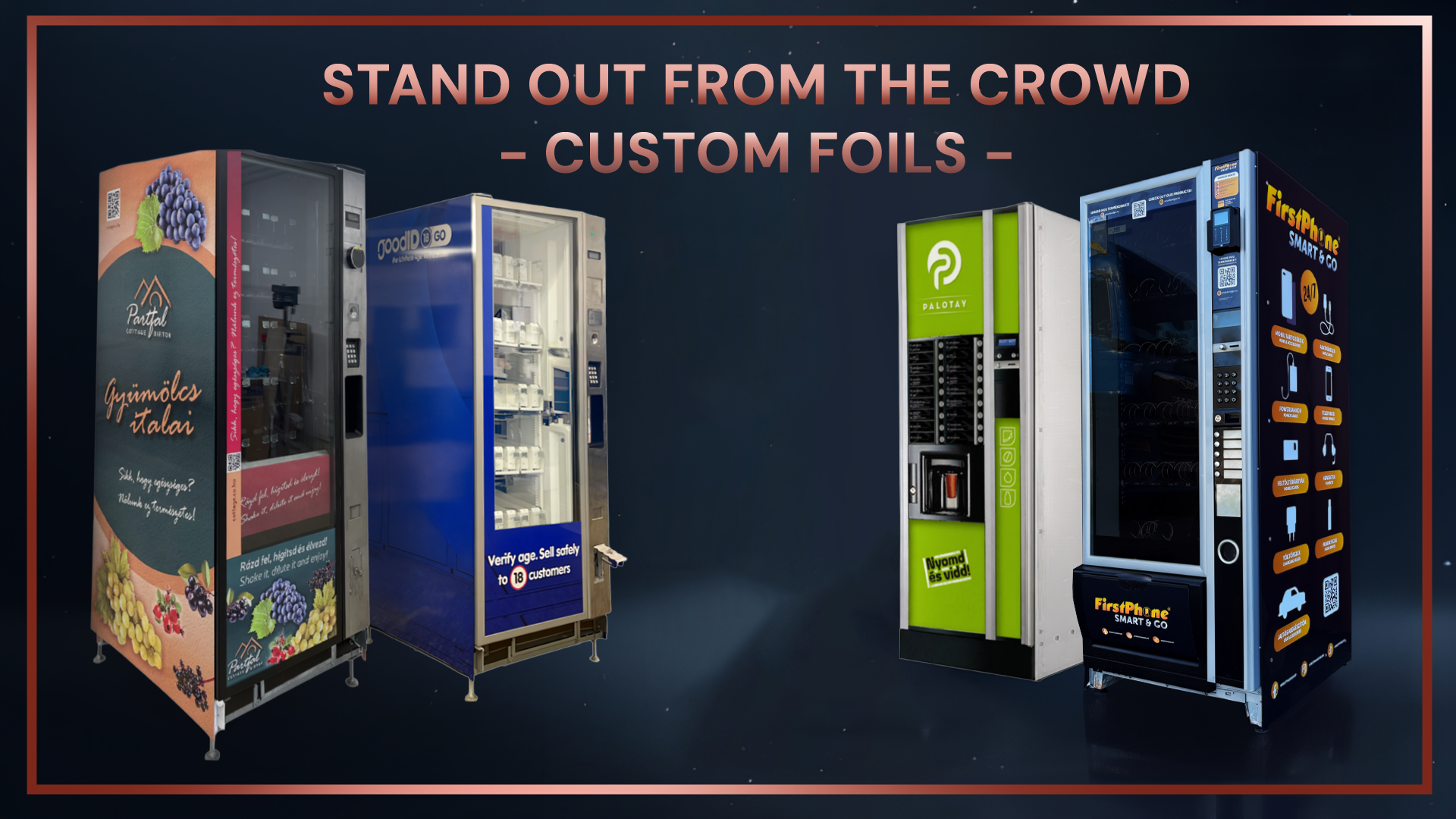
In most environments, a standard vending machine blends into the background. It serves its purpose, but it rarely attracts attention. A fully branded machine, on the other hand, does something more. It stands out, communicates value, and sets expectations before a customer even looks inside.
That transformation is exactly what a custom foil is designed to achieve.
Every project we work on begins the same way: with an idea. Sometimes that idea is clear and well-defined, aligned with an existing brand and supported by visual guidelines. Other times, it is much simpler; just the intention to move away from a plain, unbranded machine and create something that feels more considered.
Both are equally valid starting points.
Our role is to take that input and turn it into a design that works in practice. With the support of our in-house graphic designer, we develop concepts that are not only visually strong, but also tailored to the product, the brand, and the environment where the machine will be placed. Because a design in this context is not just about appearance - it needs to perform.
One of the most interesting aspects of this work is how differently the same machine can be perceived depending on its design.
Over time, we have created custom foils for a wide range of use cases. Vending machines selling locally produced honey, for example, require a completely different visual approach than machines offering car care products. In the first case, the design needs to communicate trust, authenticity, and a natural, artisanal feel. In the second, it needs to reflect performance, precision, and a more technical character.
We have also worked with businesses that wanted their vending machines to act as a direct extension of their brand; fully aligned with their identity and instantly recognizable in any location.
In each case, the machine itself remained the same. What changed was how people perceived it and whether they chose to engage with it.
That difference is not accidental. It comes from careful execution behind the scenes.
Designing a custom foil for a vending machine is not the same as creating visuals for a screen or a standard print. Every concept must be adapted to the physical structure of the machine; its dimensions, edges, opening, and functional components. A design that looks perfect digitally can quickly lose its impact if these factors are not taken into account.
Material selection is equally important. The foil must be durable, resistant to wear, and suitable for the specific environment in which the machine operates, whether that is indoors, outdoors, or in high-traffic areas.
And then there is installation. Precision at this stage is what ensures the final result looks exactly as intended; clean, aligned, and consistent with the original concept. It is often the difference between something that looks acceptable and something that feels premium.
To make this process as seamless as possible, we manage everything in-house. From the initial idea and design phase to printing and final installation, every step is handled by one team. This allows us to maintain full control over quality and ensures that the final result stays true to the original vision.
For our customers, it also means simplicity. One partner, one process, and no unnecessary complexity.
All of this matters for a simple reason; in automated retail, attention is the first step to performance.
Before a customer decides what to buy, they decide whether to stop. And that decision is often made in just a few seconds, based largely on how the machine looks and what it communicates at a glance.
A well-designed vending machine does more than improve appearance. It strengthens brand presence, makes the product easier to understand, and increases the likelihood of engagement. In that sense, a custom foil is not just a visual upgrade, it is a practical tool that directly supports results.
Because in the end, the difference between a machine that gets noticed and one that gets ignored often comes down to something very simple:
What people see first.
So the real question is
What should your vending machine say before anyone even looks inside?